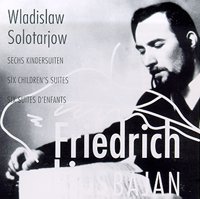
The cycle of the six Children's suites for bayan by Wladislaw Solotarjow is unique of its kind.In his music for children and young people he continues the tradition of such composers as Robert Schumann, Peter I. Tschaikowskij, Sergej Prokoffieff, Aram Chatschaturjan and Dimitrij Kabalewskij. Artistically and pedagogically these suites are of interest to an unusually large circle of bayan players. The interpretations of the suites demand diverse artistic and technical skills from all students, whether from music schools or conservatories. When performing, bayan players like to include these Children's suites in their concert repertoire, since they always are a great success and are always very popular with wide audiences.
In these pieces many different techniques are employed as well as a manigfold variety of methods of playing the instrument. Many moods and images are expressed in this music: sadness, melancholy, hesitation,joy, humor and fairylike magic. Moods alternate with images taken from nature.
The suites are very varied in their themes and styles. One can hear melodies taken from traditional Russian songs and dances as well as marches and so-called music-box music, also themes for the harmonica. Individual movements from the Children's suites somehow reflect theatrical scenes; for example the second movement of the third suite which was composed under the influence of Robert Burns' poem "Findley" and is presented expressively in dialogue form.
In the first three suites realistic stylistic images dominate. They express a more intense joy of life. The last two suites represent more abstract images. The dominant moods are sadness and melancholy.
|